Why off-mains wastewater needs an automated provisional estimate
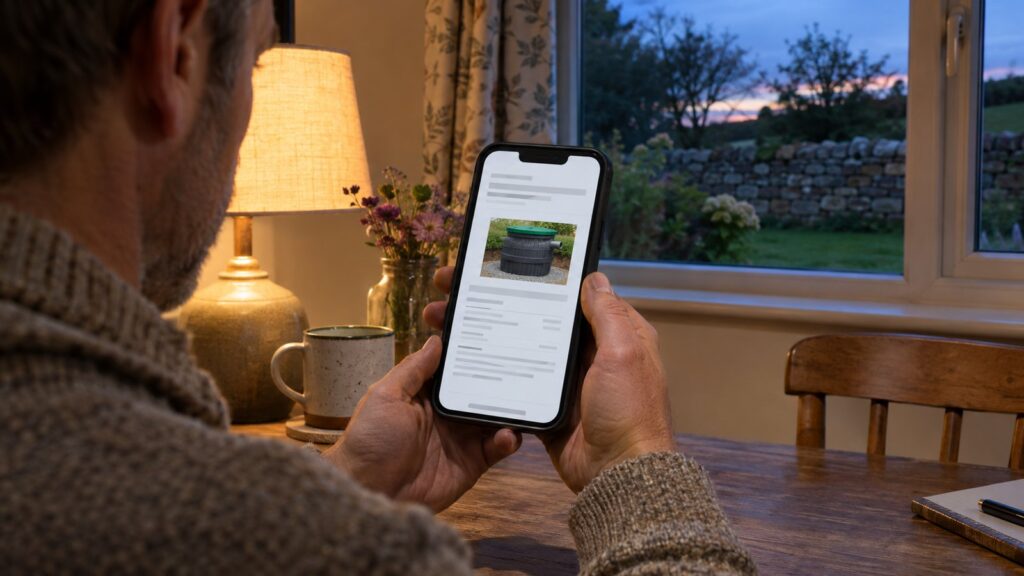
A homeowner replacing a septic tank usually starts with a simple question: what might this cost? The usual answer is that nobody can say until there has been a survey. If they also have to wait for someone to read the enquiry, call them back and work up a figure, they have time to ask two or three other installers the same question.
An automated provisional estimate gives them a useful answer while they are still looking. It also gives the installer enough detail to decide whether to call back, book a survey or pass.
This article draws on a small mystery-shop study of UK off-mains wastewater firms, run in October and November 2026. Firms are anonymised, the sample is small and the figures are a dated snapshot. It is not a ranking of any firm. It does not report results from any live network.
Why off-mains wastewater has no single price
Several things that change the price can only be checked on site:
- How the ground drains, and how wet it is through the year.
- Where the existing tank, pipes and drains actually run.
- Whether a digger and vehicle can reach the working area.
- How close the work is to boundaries, buildings, trees and watercourses.
- Where treated water can go, and what approvals, if any, are needed.
- Whether a power supply is available for any pumps or aerators.
That is why a firm price comes after the survey. It is not a reason for the customer to hear nothing before it.
What the study saw
Of 24 installers reached, 6 gave any price. One gave a firm price and 5 gave a ballpark. Three supplier replies gave prices. Two were supply-only and one did not say what the price covered. These are single cases from a small sample. They do suggest that many customers hear no number at all in the early stages.
What a provisional estimate is
A provisional estimate is a rough price range, with a suggested system, stated assumptions and a note of what the survey will confirm. It is not a quote. Where the enquiry supports it, the suggested system comes from the supplier’s approved range and is shown with an image, so the customer can see what they are likely to need.
Six reasons to automate it
1. A slow reply gives the customer time to look elsewhere
A homeowner who gets no useful response has little reason to stop searching. An automated acknowledgement confirms the enquiry arrived. A provisional estimate, where the answers support one, gives them a budget to consider and a reason to carry on the conversation.
2. A fast response gives you a better chance of being first
Enquiries arrive while installers are on site, driving or finished for the day. An automated estimate can go out as soon as the customer completes the enquiry. The installer picks it up during working hours with the details to hand.
3. Plain questions keep the customer engaged
A first response full of technical questions can leave the homeowner unsure how to proceed. Start with things they are likely to know: the work needed, the postcode, the type of property and the system already there. Let them say they are unsure about details such as the discharge route. Explain what happens next in plain English.
4. Every installer gets a consistent enquiry
A name and phone number leave the installer chasing the basics. Guided questions capture contact and job details together, in the same format every time. The installer can start the first call by checking what matters for that property.
5. An early price helps customers decide whether to proceed
Some homeowners are ready to act. Others are comparing prices or checking the work is affordable. A rough price helps them decide before anyone arranges a visit, and a suggested system gives them something concrete to compare. A customer who is not ready today can keep the estimate and come back.
6. Better qualification can save a wasted site visit
If a job is outside the installer’s area or the budget is clearly too low, it is better to find out before anyone gets in a van. When a visit makes sense, the installer already knows what to check. A reported discharge to a ditch, for example, may need review before a system can be selected and priced.
What makes a provisional estimate fair
- It is based on the minimum detail needed, asked in a consistent way.
- It gives a range, not a single figure.
- It shows the suggested system, what the price covers and what could change it.
- It says the installer confirms the discharge route and any approvals needed.
- The installer confirms the final system and the quote after the survey.
When an estimate should wait
If a key detail is unclear, the enquiry goes to the installer for review before pricing, and the customer is told the next step. Some enquiries, such as commercial and mixed-use sites, need review before an estimate can be prepared.
For more, see Why a provisional estimate still needs a site survey and What a good installer enquiry looks like. If you would like to see how this could work for your network, request a walkthrough.