A mystery-shop study of off-mains wastewater: The results are in

When a homeowner asks about replacing a septic tank, what happens next? In October and November 2026 we ran a small mystery-shop study of UK off-mains wastewater firms to find out. This article sets out the method and the main findings. A second article covers what they mean for suppliers and installers.
Firms are anonymised, the samples are small and the figures are a dated snapshot. The study is not a ranking of any firm, and it cannot show why a desk was slow or did not give a price.
How the mystery-shop study worked
Shoppers approached firms as a homeowner would. Every shopper used the same job: a four-bedroom house replacing a failed septic tank. They gave a test postcode only, with no house number.
- Installers: 52 listed. 7 were left out (5 technical faults only, 2 that do not supply or install), leaving 45 valid firms. Phone calls ran from 2 to 6 November with retries on 10 and 11 November. Web forms were submitted on 11 November.
- Suppliers: 20 shopped. A daytime phone round on 4 November, an out-of-hours phone round, and web forms, chat and sizing tools from 6 to 11 November.
- Builders’ merchants: 21 branches called on 5 November.
The counting rules were set in advance:
- Technical faults and firms that do not supply or install are left out of the percentages.
- Phone and web form results are kept separate, and phone figures are per firm, not per call.
- A request for an address is treated as a method effect, because shoppers gave a postcode only. It is never counted as a stall.
- Reply times are elapsed hours from the first submission.
What the study found
Installers by phone
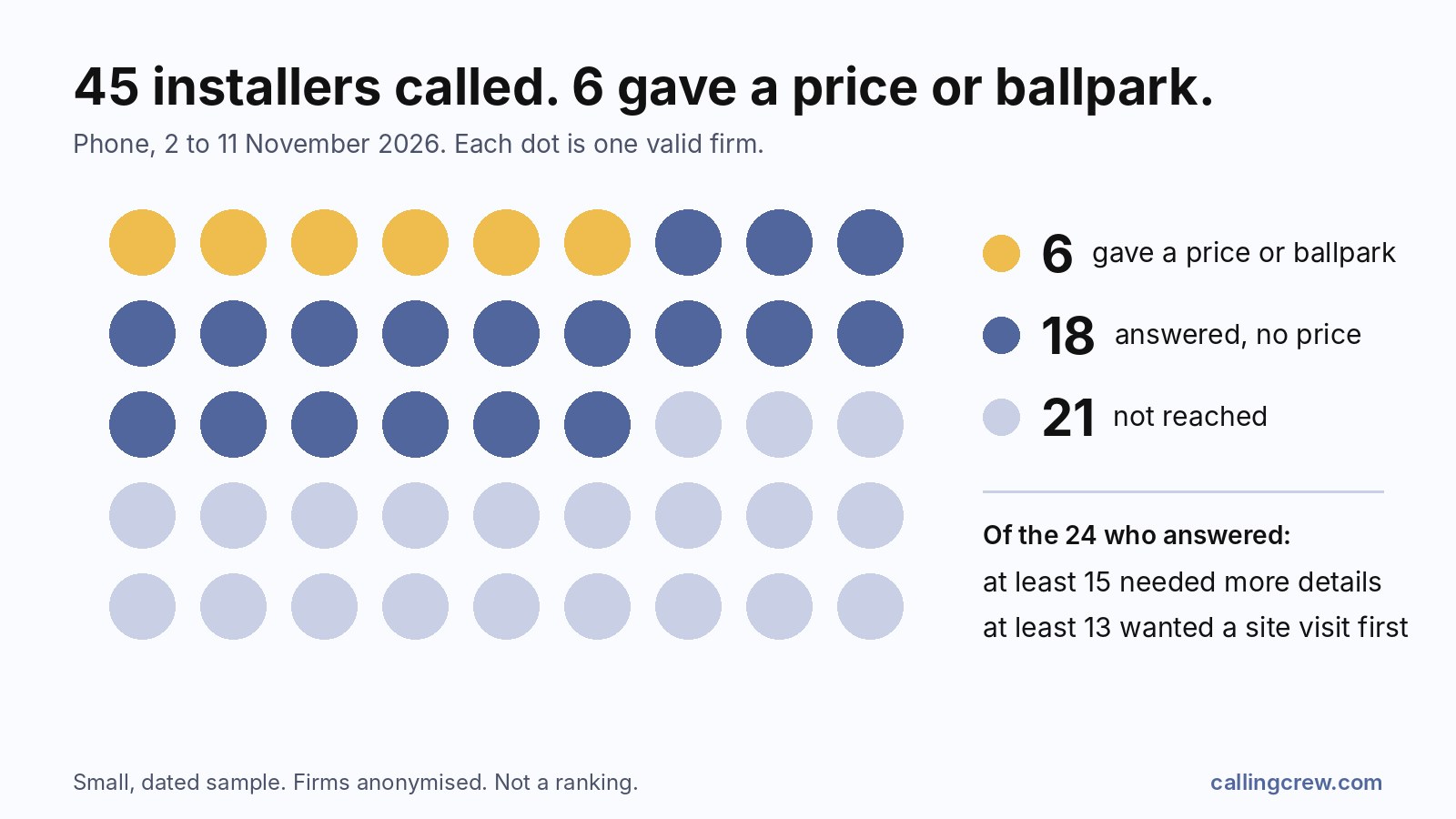
Shoppers reached a person at least once at 24 of 45 valid installers. Of those 24:
- 6 gave a price or ballpark. The rest gave no price.
- At least 15 needed details before they could say more.
- At least 13 wanted a site visit first.
Installers by web form
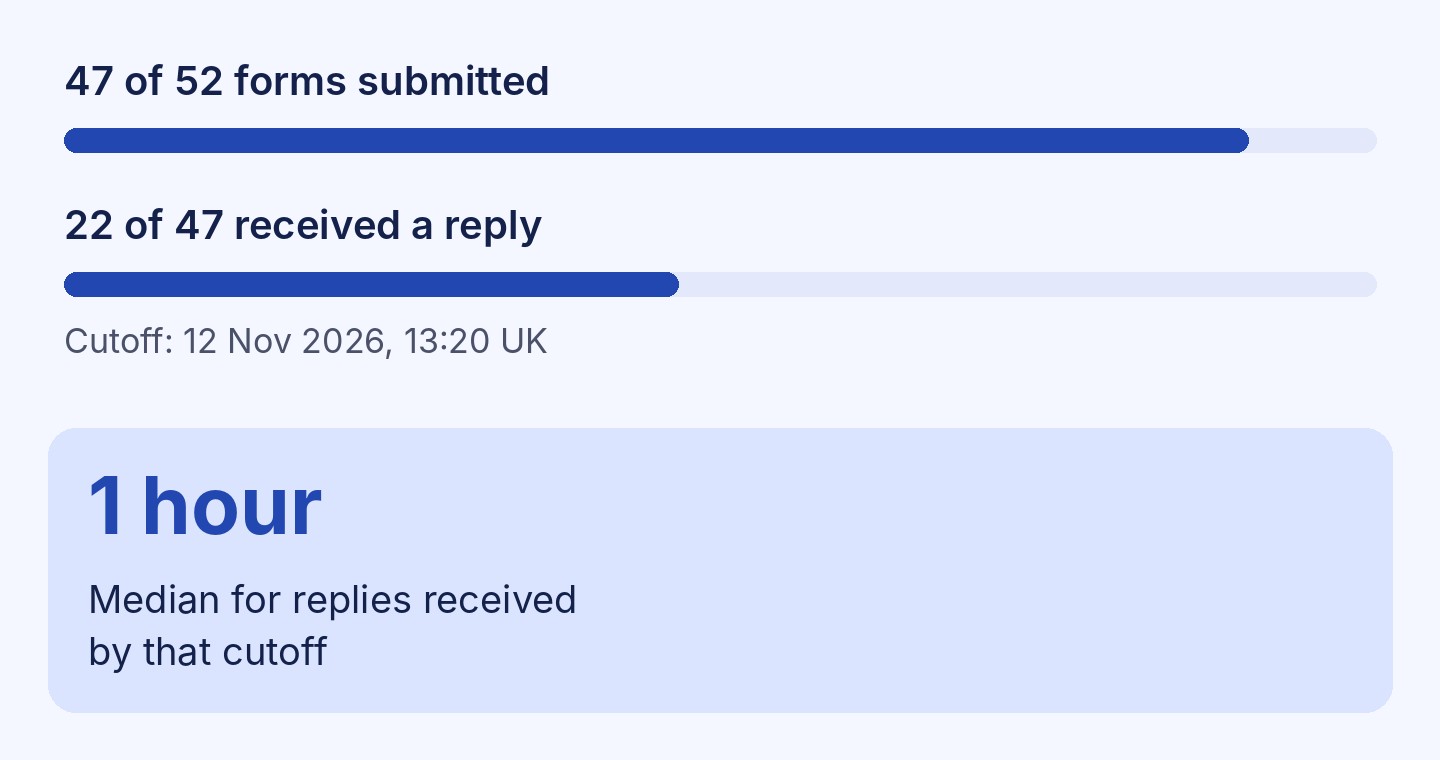
Shoppers submitted 47 of 52 installer web forms on 11 November. By 13:20 UK time on 12 November 2026, 22 of the 47 submissions had received a reply. Among the replies received by that cutoff, the median elapsed time from submission was one hour. The fastest reply took about 7 minutes and the slowest 22.8 hours. Two replies gave a ballpark price with unspecified scope. None gave a firm price. Fifteen of the 47 submitted forms asked for a location.
Suppliers
- Phone, working hours: 14 of 16 valid firms answered by a person. 4 of the 14 gave a price.
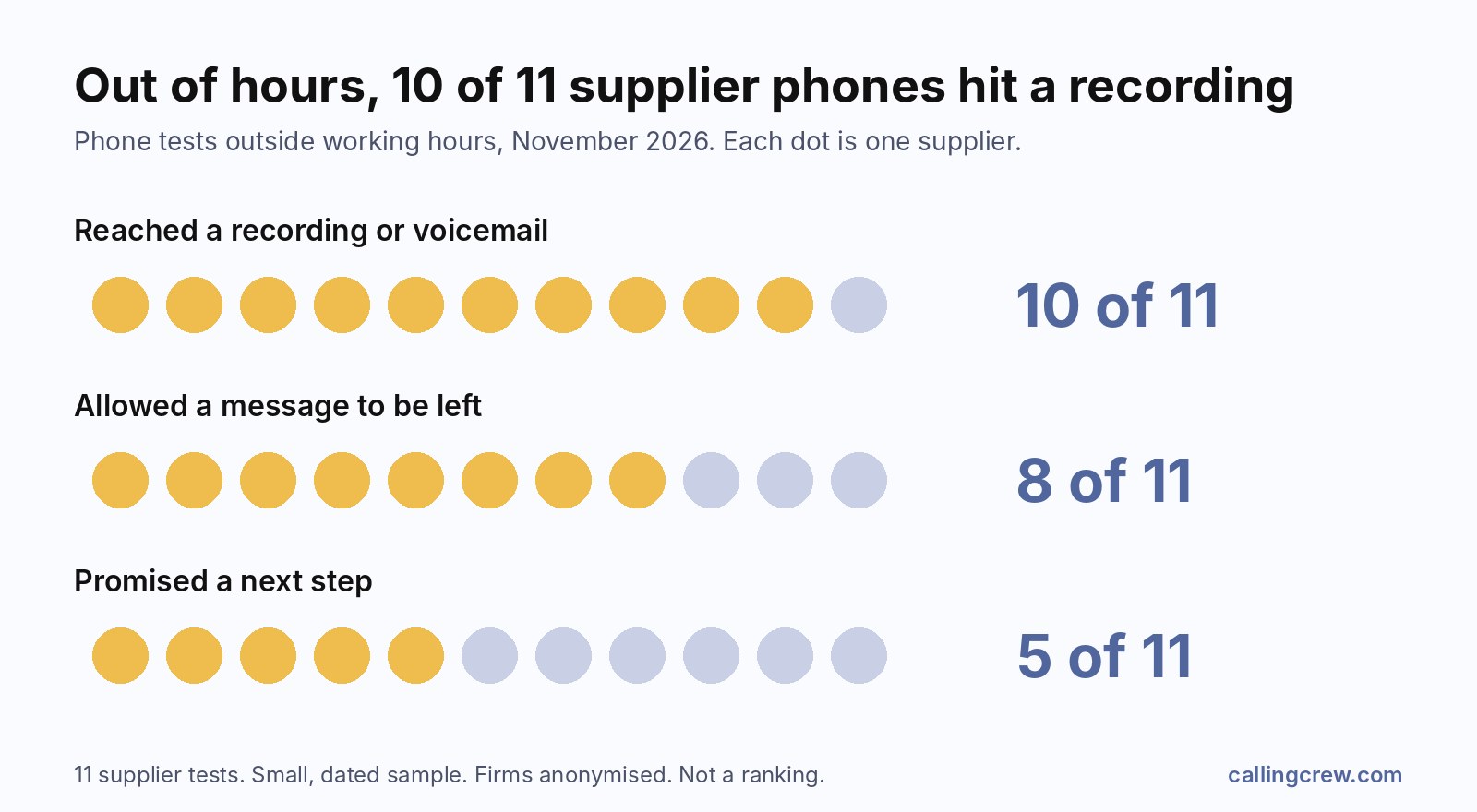
- Phone, out of hours: 10 of 11 supplier tests reached a recording or voicemail. 8 of 11 allowed a message to be left, and 5 of 11 promised a next step.
- Web form, chat and sizing tools: at least 11 human replies from 15 valid firms. The fastest took about 8 minutes and the slowest about 90 hours. 5 firms gave a price, estimate or ballpark, from £1,682 to £15,768. The scope varied across prices.
Builders’ merchants
Of 14 valid branches, 12 answered by a person. None gave a price. 9 of the 12 asked three or more questions.
Handoffs
One supplier’s sizing tool introduced an installer 1 hour 44 minutes after a repeat submission. In another case, a firm the shopper never contacted wrote about 3 days after a phone call, having been passed the enquiry by an installer. At one supplier, two salespeople wrote on the same day. These are single cases, not typical results.
What the study cannot show
- Why a firm was slow or gave no price. The study sees what the homeowner sees, not what happens inside an inbox.
- Whether the firms are representative of the whole market.
- What happens after the first replies. Some counts may still rise.
For a journey view of one enquiry, see One enquiry, four desks. For the nine gaps behind the pattern, see Nine gaps between a homeowner’s enquiry and a price.
Study notes: UK firms, October to November 2026. Small, dated samples with the denominator stated. Firms anonymised. Phone and web form results are counted separately, and phone figures are per firm. Reply times are elapsed hours from the first submission. Counts are as of 13 November 2026 and may still rise. Not a ranking of any firm.